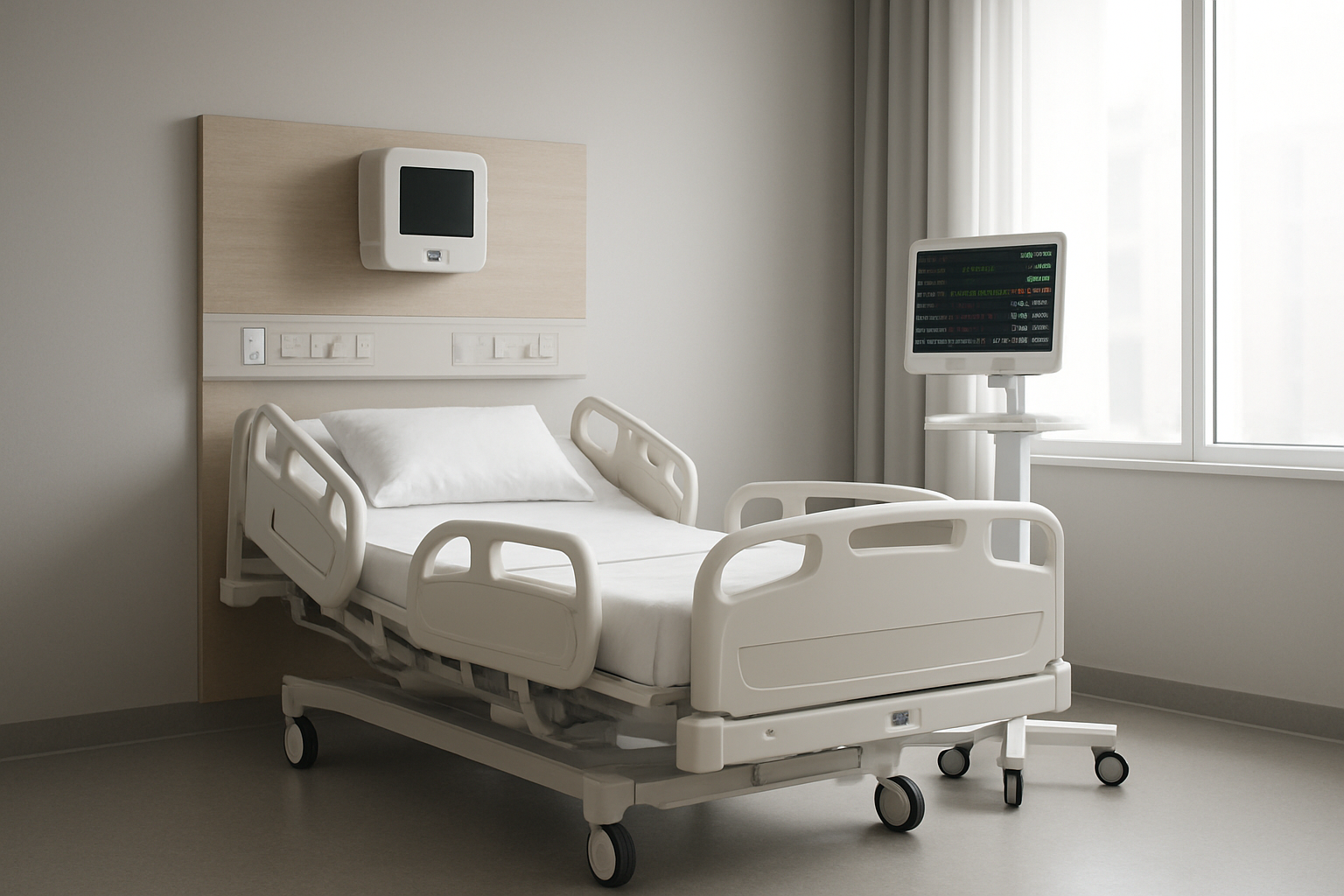
Hospital furniture used to be judged on two things: durability and how easy it was to wipe down. That standard hasn’t gone away, but in 2026 it’s no longer enough. A new generation of beds, chairs, carts, and workstations now think, sense, and respond — and the driving force behind that shift is artificial intelligence.
AI hospital furniture design is no longer a research-lab concept. It’s showing up in real procurement decisions, real patient rooms, and real hospital budgets, as facilities look for ways to cut nurse workload, prevent falls, and get more value out of every square foot of clinical space. For manufacturers and healthcare buyers alike, understanding where this technology is headed is quickly becoming a competitive necessity rather than a curiosity.
This article breaks down exactly how AI is reshaping hospital furniture design in 2026 — from smart beds and predictive maintenance to manufacturing itself — and what it means for hospitals, designers, and furniture makers moving forward.
Why AI Is Entering Hospital Furniture Now
Three pressures have converged to push AI into furniture that used to be purely mechanical.
Staffing shortages. Nurses are stretched thinner than ever, and hospitals are actively looking for technology that reduces manual monitoring tasks — checking on patients, repositioning them, tracking vitals by hand. Furniture that can do some of that work on its own is an easy sell to an overworked care team.
Patient safety demands. Falls, pressure ulcers, and missed early-warning signs remain some of the most preventable — and most costly — incidents in inpatient care. Regulators and insurers are increasingly rewarding facilities that can demonstrate proactive risk reduction, and AI-equipped furniture provides exactly that kind of documentation trail.
Falling sensor and compute costs. Weight sensors, pressure mapping pads, accelerometers, and small onboard processors have all become cheap enough to build into standard hospital furniture without pushing prices out of reach. What was experimental five years ago is now a viable line item in a manufacturing bill of materials.
Put together, these pressures mean AI is no longer an add-on feature pitched by a handful of premium brands — it’s becoming an expected baseline in serious healthcare furniture procurement.
Smart Beds: The Clearest Example of AI in Action
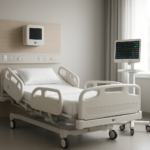
If there’s one product category where AI hospital furniture design is most visible, it’s the hospital bed. Modern smart beds go far beyond electric height and incline adjustment. They now commonly include:
- Pressure-mapping mattresses that continuously read where a patient’s weight is concentrated and flag conditions likely to cause pressure ulcers before skin damage occurs.
- Movement and position sensors that can distinguish between a patient shifting in sleep and a patient attempting to get up unassisted — the single biggest predictor of an inpatient fall.
- Vital-sign integration, where the bed itself becomes a passive monitoring point for heart rate and respiratory rate, feeding data back to the nursing station without a single wearable or manual check.
- Predictive alerts, where AI models trained on movement and vital-sign patterns learn what “before a fall” or “before a medical event” typically looks like for a given patient, rather than reacting only after a threshold is crossed.
This is often described as ambient monitoring — the bed becomes a first responder of sorts, catching subtle changes long before a human would notice them during a scheduled round.
Beyond the Bed: Chairs, Carts, and Workstations Get Smarter Too
While beds get most of the attention, AI is quietly changing almost every other category of hospital furniture as well.
Seating. Patient and caregiver chairs increasingly include occupancy and posture sensors that flag when a patient has been sitting too long without repositioning — a known risk factor for skin breakdown in long-term and rehabilitation care.
Nursing stations and clinical workstations. Height-adjustable desks and mobile workstations now come with usage analytics that help facilities understand which spaces are underused, overcrowded, or poorly positioned relative to actual patient flow — data that used to require expensive manual time-motion studies.
Storage and supply carts. RFID and computer-vision-enabled cabinets can track medication and supply inventory automatically, flagging low stock or expired items without a manual audit, and integrating directly with hospital inventory systems.
Room-level furniture systems. Some facilities are moving toward furniture that talks to the room itself — beds, chairs, and even lighting coordinating through a shared system that understands whether a room is occupied, being cleaned, or in active use, and adjusts accordingly.
None of these are flashy on their own, but together they represent a meaningful shift: furniture is becoming an active data source for hospital operations, not just a physical object in a room.
AI Is Also Changing How Hospital Furniture Is Designed and Made
The impact of AI isn’t limited to the finished product sitting in a patient room — it’s reshaping the design and manufacturing process behind that furniture too.
Predictive space planning. Designers now use AI models trained on patient admission trends and space utilization data to plan furniture layouts before a single piece is ordered, reducing costly reconfiguration later.
Digital twin simulation. Manufacturers can simulate how a proposed bed, chair, or cart will actually perform in a modeled hospital environment — testing clearance, workflow impact, and even cleaning-cycle compatibility — before committing to physical prototypes.
Generative and assisted design. AI design tools are being used to explore structural variations of frames and components that reduce material use and weight while maintaining the load ratings hospital furniture requires, supporting both cost control and the industry’s growing sustainability requirements.
Automated quality and compliance checks. Computer-vision inspection on production lines is catching manufacturing defects — weld inconsistencies, surface flaws, misaligned components — far earlier and more consistently than manual spot-checks alone.
For manufacturers, this means AI isn’t just a feature to sell; it’s becoming a tool that shortens development cycles and reduces the cost of getting a new furniture line to market.
The Business Case: Why Hospitals Are Paying Attention
Hospital administrators don’t adopt new furniture categories because a technology is interesting — they adopt them because the numbers work. A few reasons AI-enabled furniture is gaining real budget traction in 2026:
- Lower fall-related costs. Falls extend hospital stays and can trigger reimbursement penalties; furniture that predicts and prevents them has a direct, measurable return.
- Reduced nursing burden. Passive monitoring built into furniture reduces the number of manual checks required per shift, freeing staff for higher-value care.
- Better asset utilization. Usage data from smart furniture helps facilities right-size purchases instead of over-ordering “just in case,” which matters as capital budgets tighten.
- Longer product life through predictive maintenance. Sensors that flag wear on motors, hydraulics, or joints before failure reduce emergency repairs and extend the useful life of expensive equipment.
For furniture manufacturers, this means the sales conversation is shifting away from material quality and finish alone, toward a broader pitch built on data, outcomes, and total cost of ownership.
Challenges That Still Need to Be Solved
AI hospital furniture design isn’t without friction, and it’s worth being honest about the current limitations.
Data security and privacy. Furniture that continuously collects patient movement and vital-sign data becomes part of the hospital’s broader cybersecurity surface, and needs to meet the same compliance standards as any other connected medical device.
Integration complexity. A smart bed from one manufacturer doesn’t always talk cleanly to a nurse-call system or electronic health record from another vendor, and interoperability standards are still catching up to the pace of hardware innovation.
Upfront cost. Sensor-equipped furniture costs more than its purely mechanical equivalent, which can be a hard sell for facilities in cost-constrained markets, even when the long-term case is strong.
Staff training and trust. Alerts are only useful if nursing staff trust them enough to act — and trust takes time to build, especially if early alert systems produce too many false positives.
These aren’t reasons to avoid the technology, but they are the questions any hospital or manufacturer should be asking before committing to a large-scale rollout.
What This Means for Hospital Furniture Buyers in 2026
For procurement teams and facility planners evaluating furniture this year, a few practical takeaways stand out:
- Prioritize interoperability over any single vendor’s proprietary ecosystem — furniture that can plug into existing hospital information systems will age far better than a closed, siloed solution.
- Ask for outcome data, not just feature lists. Manufacturers with real deployment data on fall reduction or pressure-injury prevention are further along than those still describing theoretical benefits.
- Start with high-risk units. ICU, geriatric, and post-surgical wards typically see the fastest and clearest return on AI-enabled beds and monitoring furniture, making them a logical starting point for phased adoption.
- Factor in total cost of ownership, including predictive maintenance savings, not just the upfront purchase price.
Where This Is Heading
The direction is clear: hospital furniture is steadily becoming part of the hospital’s broader technology stack rather than a separate, purely physical category. As sensor costs keep falling and AI models get better at interpreting subtle patient data, expect to see this intelligence spread from beds and chairs into nearly every fixed and mobile asset in a clinical environment — carts, cabinets, workstations, and beyond.
For manufacturers, the opportunity lies in building furniture that is genuinely useful as a data source, not just technology for its own sake. For hospitals, the opportunity is a safer, more efficient care environment built on furniture that finally does more than sit in the room.
AI hospital furniture design in 2026 isn’t about replacing clinical judgment — it’s about giving care teams better information, sooner, from objects that were previously silent. That shift is quietly becoming one of the most consequential changes in modern healthcare infrastructure.